Apply Liouville–Arnold carefully
Does conserved energy make every pendulum trajectory periodic? On the pendulum’s cylindrical phase space, regular librations and rotations are periodic, but the separatrix is not. You will apply the Liouville–Arnold hypotheses to each energy regime, derive the two different period formulas, and identify what changes when the angle is unwrapped onto a line. This is a one-degree-of-freedom example: its conclusions concern the undamped, undriven pendulum and the stated phase space.
Required background. Use Hamilton’s equations and differentiate an energy function; the Hamiltonian bridge supplies those rules. The period calculations use trigonometric identities and substitutions in definite integrals.
Helpful background. Solve an oscillator two ways explains circle-valued angles. Build actions and angles constructs a nonlinear example. The Liouville–Arnold reference gives the general theorem and proof outline.
The pendulum lives on a cylinder
Section titled “The pendulum lives on a cylinder”Use dimensionless variables
with Hamiltonian and canonical bracket
Angles differing by represent the same configuration. Drawing therefore requires identifying the two vertical edges. The units set the small-amplitude angular frequency to one; dimensional time would restore its inverse as the time scale.
Hamilton’s equations and the energy differential are
Energy is conserved because . Write its value as . A point is regular for when : at least one of and must be nonzero. There are just two critical points on the cylinder: the bottom equilibrium at and the upright equilibrium at . The latter is a saddle: writing gives the linearized equations , .
Entry check: conserved does not mean periodic
Section titled “Entry check: conserved does not mean periodic”
A proposed argument says: “This system has one conserved energy for one degree of freedom. Every nonempty energy level is bounded in and closed on the cylinder. Hence every trajectory is periodic.” Which theorem hypotheses have not been checked?
Check and repair
Compactness alone is insufficient. One must check regularity everywhere on the component and distinguish a connected component from the entire energy level. At , the level includes a critical point. At , it has two components. We will find nonperiodic separatrix trajectories even though the pendulum remains Liouville integrable on its regular set.
Apply the theorem to a connected regular component
Section titled “Apply the theorem to a connected regular component”For this one-degree-of-freedom Hamiltonian, the sufficient hypotheses are particularly concrete. Choose a connected component of ; require it to be compact and require at every point of it. Involution is automatic because .
Then is a circle, and a neighborhood of it admits canonical action–angle coordinates. In these coordinates and
Regularity makes nonzero there. Thus each orbit on this one-dimensional torus has a finite period. This is the compact-component application of Cannas da Silva, January 2006 revision, § 18.4, Lemma 18.11 and Theorem 18.12, pp. 110–111, PDF. The theorem supplies coordinates near the chosen circle; it does not supply a chart across a singular energy or join disconnected components into one torus.
Here the levels can be classified directly:
| Energy | Level on the cylinder | The compact regular-circle conclusion |
|---|---|---|
| Empty | No component to consider. | |
| Bottom equilibrium | Critical point, not a regular circle. | |
| One libration circle | Applies to that component. | |
| Two separatrix loops meeting at the saddle | Fails regularity at their meeting point. | |
| Two rotation circles, one for each sign of | Applies separately to each component. |
To verify compactness, observe that implies . The level is a closed subset of the compact cylinder segment . For , its two momentum branches join at turning points and form one circle. For ,
never vanishes: the two graphs remain separate, and each winds once around the cylinder. Libration means back-and-forth motion; rotation means motion with a fixed sign of . Both are periodic states on the cylinder, even though a continuously lifted rotation angle changes by per circuit.
The phase portrait should be read with its vertical edges identified; a rotation does not stop when it reaches an edge.
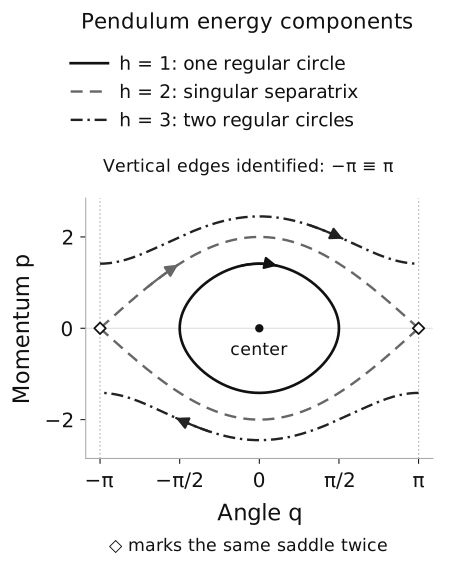
Exact contours of at . Identify with : the two diamond markers represent one saddle. The libration and each rotation component are compact regular circles on the cylinder; the separatrix is singular. Arrows follow . All quantities are dimensionless.
Derive the two physical periods
Section titled “Derive the two physical periods”The period follows from , with the sign of chosen for the direction of travel. Define the complete elliptic integral of the first kind by
Here is the modulus, not the parameter . This convention is DLMF equations 19.2.4 and 19.2.8. Defining the integral fixes the notation independently of any software convention.
Libration: four quarter-orbits
Section titled “Libration: four quarter-orbits”For , the positive turning point is
Symmetry divides the oscillation into four equal travel times, giving
Set and . On this quarter-orbit,
Their ratio cancels the turning-point zero and yields
The integrand in the transformed variable is finite at for each . A turning point alone does not make the physical period diverge.
Rotation: one circuit of the cylinder
Section titled “Rotation: one circuit of the cylinder”For , take and integrate over a change of a lifted angle. Put . Then
Reflecting the second half of the integral gives
For , both and reverse sign, so the positive elapsed time is identical. Reusing the libration prefactor without this derivation would count a different journey. At large , and , as expected for almost uniform rotation with speed .
Small oscillations and approach to the separatrix
Section titled “Small oscillations and approach to the separatrix”As , and . Therefore
Expanding the defining integrand uniformly for small gives , hence . This agrees with from linearizing . The limit is a period of nearby nonzero oscillations; the equilibrium itself does not trace a regular circle or have a least positive return time.
From either side of , the relevant modulus tends to one. At the integrand becomes , whose integral diverges at . Thus both periods diverge. The integrals increase to this divergent limit as .
More precisely, the leading term of DLMF equations 19.12.1 and 19.12.3 gives , with . For an equal positive energy offset this implies
The ratio tends to two, although both times diverge. A nearly separatrix libration makes two slow visits near the upright orientation in a full oscillation; one rotation makes one. These limits do not assign a finite period at .
The separatrix is not a periodic orbit
Section titled “The separatrix is not a periodic orbit”On , the upper separatrix obeys . One exact trajectory on it is
The hyperbolic functions used here mean
Differentiating these formulas verifies
At it passes through . As and , it approaches and , respectively: the same saddle on the cylinder. It never reaches that point in finite time. Such a trajectory is called homoclinic. Reversing time and momentum gives the lower one.
The full level is compact, but contains the critical saddle and is not a regular circle. Removing the saddle leaves two regular trajectories, each noncompact: each omits its limiting point. Neither operation repairs both hypotheses at once. The elementary Liouville condition still holds away from the two critical points; what fails is this compact regular-torus application, not conservation of energy.
Exercises
Section titled “Exercises”Guided: a turning point can be regular
Section titled “Guided: a turning point can be regular”
Start at . Find , evaluate and the Hamiltonian vector field there, and identify the connected energy component. Does the theorem apply? Express the full period in terms of , with its argument clearly identified.
Hint
Regularity tests both coefficients of , not only . The point is the positive turning point of its libration.
Solution
The energy is , and
The state is momentarily at rest in position, but the full phase-space vector field is nonzero. Its component is the compact regular libration circle with turning points . The theorem applies, and , using modulus rather than parameter .
Independent: remove the saddle?
Section titled “Independent: remove the saddle?”
At , assess the claim: “Delete the saddle to obtain regular circles; the remaining trajectories must therefore be periodic.” Identify what fails before and after deletion. Use the explicit trajectory to distinguish returning to a point from approaching it asymptotically. Contrast this with the two components at .
Hint
A bounded subset need not be compact if it omits a limit point. Check whether either separatrix trajectory contains its limiting saddle.
Solution
Before deletion, regularity fails at the saddle. After deletion, the two homoclinic trajectories are regular but noncompact, not circles. Along the displayed upper trajectory, increases strictly between and ; the saddle is only approached as . There is no finite return to .
At , the graphs contain every angle and satisfy . Each is a compact regular circle; the theorem applies separately. Both have period . Two components do not obstruct the componentwise theorem; a singular meeting point does.
Transfer: unwrap the configuration space
Section titled “Transfer: unwrap the configuration space”
Keep the same Hamiltonian and equations, but now take : positions differing by are distinct. Classify connected energy components for and . Which compact-torus conclusions survive? Does this change destroy Liouville integrability? Interpret the old rotation-period integral and the separatrix endpoints in the lifted space.
Hint
Each potential well is centered at , . A rotation keeps moving through successive wells; no edge identification returns it to its initial .
Solution
For , there are infinitely many separate compact libration circles, one in each well. The theorem applies to each. For , there are two noncompact graphs over the entire real axis, distinguished by the sign of . They are regular, but neither is a torus. Since , a rotation’s lifted position is unbounded and never returns.
The old is now the finite travel time for a change of in , not a period of the state. Energy still supplies one integral with nonzero differential on an open dense set, and : the system remains Liouville integrable. Topology changed the compactness and recurrence conclusion.
The displayed separatrix now approaches two distinct saddles, and . It is heteroclinic in the lifted space, meaning that its past and future limits are different equilibria. This change of name reflects the changed identification of points, not changed local equations.
Use the hypotheses beyond the pendulum
Section titled “Use the hypotheses beyond the pendulum”The quartic action–angle construction explicitly builds coordinates on regular closed curves. For an interacting system, continue to open Toda, where independence and involution require work and the full common levels have an unbounded translation direction. The theorem reference explains why that distinction matters before invoking compact tori.
References
Section titled “References”- Cannas da Silva, Ana. Lectures on Symplectic Geometry. Lecture Notes in Mathematics 1764, Springer, 2001. DOI. Author revision January 2006, PDF, § 18.4, printed pp. 109–111, especially Lemma 18.11 and Theorem 18.12. The pendulum regimes and periods above are derived directly.
- NIST. Digital Library of Mathematical Functions, Chapter 19, “Elliptic Integrals.” Version 1.2.8, released 15 September 2026. Equations 19.2.4 and 19.2.8: first-kind integrals and the complete case; equations 19.12.1 and 19.12.3: expansion near unit modulus. Only real moduli between zero and one are used here.